CONSERVATIVE TREATMENT OF INTERVERTEBRATE HERNIA
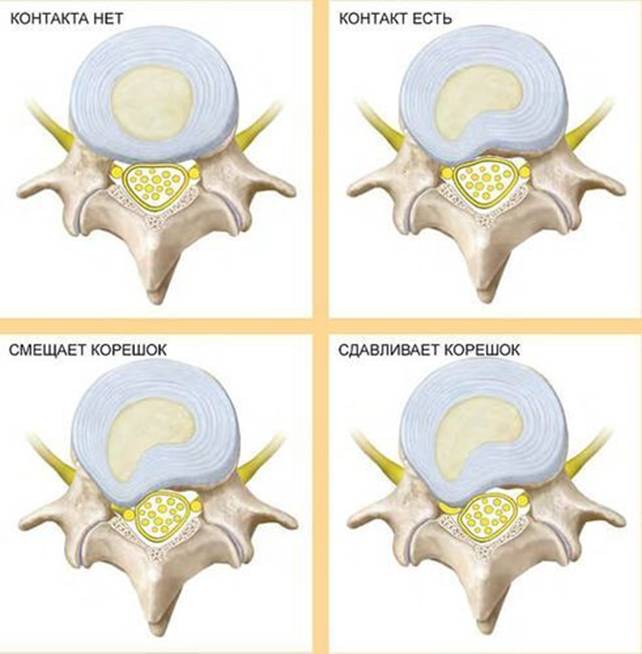
Hernias occur in any part of the spine, but most often in the cervical and lumbar, since they are the most mobile. Hernia is a protrusion of the nucleus pulposus of the disc through a crack in the fibrous ring. In this case, the protrusion can be of varying degrees. The minimum protrusion is called a “protrusion”. A more significant one is a hernia. Sometimes a fragment of the nucleus pulposus breaks off and completely exits into the spinal canal, which is called a sequestrum.

By themselves, herniated discs are manifested by pain in the corresponding part of the spine, which is aggravated in an upright position and when leaning forward. If the hernia presses on the nerve roots, the pain radiates to the limb (or arm or leg), can cause numbness and a decrease in strength in them. It is not so much the size of the hernia that is important, but its location. If it is localized in the center of the spinal canal, then with a sufficiently “large” size, the patient can be cured without surgery. And if the hernia is displaced to the side or is located in the root canal, the probability of recovery without surgical intervention is significantly reduced.
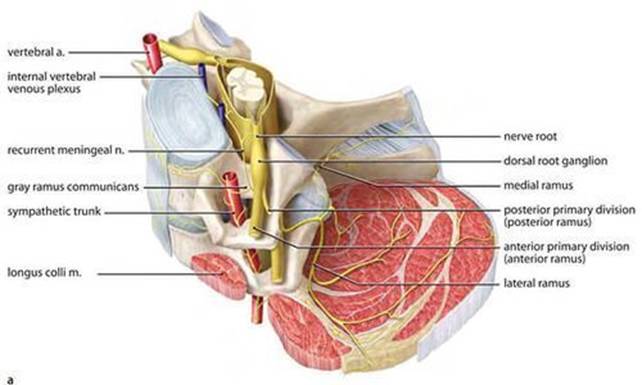
The causes of pain in osteochondrosis of the spine can be other conditions that are not related to herniated intervertebral discs. Therefore, for differential diagnosis and selection of treatment tactics, a personal consultation with a specialist in the neurosurgical department who has the full range of modern treatment methods is necessary.
This is what one functional segment of the cervical spine looks like. Every structure that is included in it (muscles, bones, cartilage, ligaments and neural structures) can be a source of pain.
At the first stage of treatment of “osteochondrosis” of the spine, conservative therapy is always carried out, which includes special restrictions on the regimen and physical activity, physiotherapy, painkillers and anti-inflammatory drugs. Most often, patients can be cured conservatively. The conservative method is also used in cases where the question of the need for surgery arises, but there are still chances to avoid it. If the first stage of treatment does not help, then more effective methods are used – analgesic and anti-inflammatory blockades, special types of blockades under X-ray control or ultrasound navigation. Our patients have a whole range of physiotherapy procedures and experienced physical therapy instructors at their disposal. Most patients can be cured by these methods, especially if the patient wishes, his perseverance and active cooperation with the department’s specialists. We have extensive experience and special developments in the treatment of “osteochondrosis” of the spine.
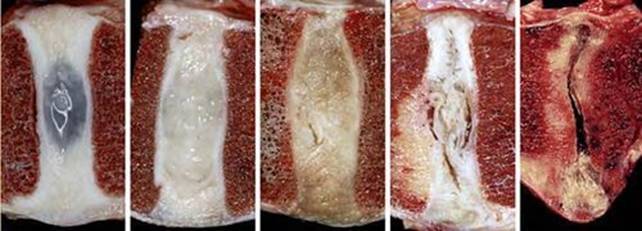
Age-related changes in intervertebral discs reflect different phases of disc degeneration:
In the future, resort treatment methods are used in sanatoriums in the Kherson region and throughout Ukraine.