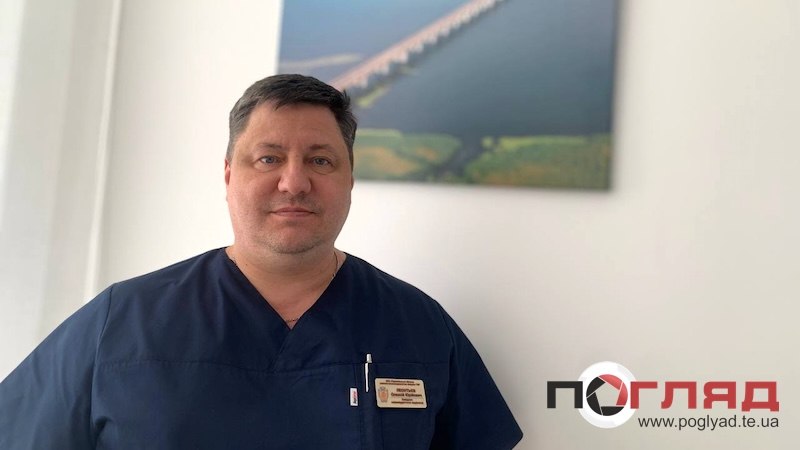
“Poglyad” began a series of materials about neurosurgeon Oleksiy Leontiev, a doctor with over 20 years of experience, who today heads the neurosurgical department of the Ternopil Regional Clinical Psychoneurological Hospital, and before the full-scale war worked in Kherson.
In the first part of the interview, we talked about his path into the profession – from his first shifts and work without modern diagnostics to leading the department.
This part of the interview is about work during the occupation of Kherson, moral dilemmas, fear, responsibility, and the path to leaving the city.
Part 2
After years of work in medicine, difficult shifts, and becoming a neurosurgeon and head of the department in Kherson, Alexey Leontiev’s professional path took on a completely different dimension.
Before the full-scale war, he headed one of the most difficult departments, worked with severe injuries and patients, made decisions in conditions of limited diagnostics and high responsibility. But the experience he had to endure in 2022 went far beyond medicine.
Working in an occupied city, constant danger, lack of basic conditions, and at the same time the need to operate and save lives every day – this is the reality in which the doctor and his colleagues found themselves.
– Tell us about your experience working under occupation.
– On the first day we went to work – and in fact we couldn’t leave. The Russian military was constantly moving around, shooting in different directions.
At that time, the fighting was going on for the Antonivskyi Bridge, a crossing over the Dnieper. On one side was Oleshky, on the other was Kherson. Our soldiers were there at first, then they left, and it was for this bridge that the fighting was going on.
The wounded were brought to us en masse. For the first two weeks, we didn’t leave the hospital at all – we practically lived at work, because we were constantly receiving and operating.
Later, when the city was already occupied, checkpoints appeared, things became a little “calmer” – at least they stopped shooting indiscriminately. Then it was possible to go out sometimes.
The family was at home at the time, hiding in the basements. Military planes were flying – sounds we had never heard before. It was a constant feeling of danger.
We continued to work. We helped our wounded a lot. Russian soldiers also ended up in the hospital, but there was only one case with neurosurgical pathology. It was not a soldier – a man from Crimea who hit a woman at high speed and was injured himself. We found a way to deny him treatment, said that we did not have the necessary capabilities, and took him away.
The most difficult thing was not only professional. There was a shortage of medicine, food disappeared – the markets were closed. Volunteers who brought at least minimal supplies were very helpful.
We also buried our wounded soldiers in such a way that the occupiers did not know that they were Ukrainian soldiers – they changed their clothes, documents, and medical records.
It was scary. I especially remember the moment when there was no communication – it was being jammed. My family and I were standing in a place where we could still catch a signal and make a call. There were a lot of people there.
And at that moment, Russian soldiers were passing by – and they just pointed their guns at us. People are standing, calling, and they point their guns at them. That was when it was really scary – for the child, for the family. Because you understand: if they start shooting, you won’t be able to do anything.
We tried to move around the city as little as possible, to hide more. But I went to work all the time.
There were other situations. For example, locals came and demanded a referral to Simferopol. I replied that I could only give referrals to Ukrainian medical institutions – for example, to Kyiv. Because of this, conflicts arose.
I had a Ukrainian flag hanging in my office and certificates for volunteer assistance since 2014. This was also noticed, there were complaints. I was even told that they could “come.”
And this was against the background of the fact that we continued to operate. For example, there was a girl from Skadovsk – her skull was damaged by a rocket fragment. We saved her, and later planned a recovery operation.
We had this surgery, and the very next day – June 26, 2022 – we decided to leave.
We gathered two cars, and more colleagues joined us. We drove across the Antonivskyi Bridge – it was already damaged, but passable. And that same evening, it was completely destroyed.
We drove through Crimea, then through Georgia. At the border, other familiar doctors joined us, and a convoy of several cars formed. We drove quickly, almost without stopping.
In Georgia, for the first time, we felt like we could breathe a sigh of relief. There was a lot of support there – there were Ukrainian flags everywhere in Tbilisi.
It was a strong feeling – after everything I had been through.
In the third part, you will learn about Oleksiy Leontiev’s new start in Ternopil, about the team, and how he managed to create one of the best neurosurgical departments in Ukraine.
Communicated by Nadiya Gresa
Source https://poglyad.te.ua/holovni/vryatuvaty-i-vyzhyty-istoriya-nejrohirurga-oleksiya-leontyeva-z-okupovanogo-hersona.html