An interesting surgical intervention was recently performed in the neurosurgical department of the Ukrainian National University Hospital. A patient with ankylosing spondylitis (Bechterew’s disease) underwent surgical treatment of a complex spinal fracture.
In patients with ankylosing spondylitis, excessive ossification of the ligaments occurs, which leads to the fact that all the vertebrae grow together into a single conglomerate, resembling a bamboo stick. The spine conditionally becomes one bone, which leads to the loss of many types of movements. In addition, osteoporosis develops in the spine, i.e. the bones become much softer than normal, and also more fragile.
When the spine is injured, it breaks and forms an extremely unstable injury. The spine is divided by the fracture line into 2 fragments, the movements between which are extremely large, which can lead to damage to the nervous structures located in the spine. Injuries in this disease often occur in the area of maximum mobility, i.e. in the cervical or lumbar region.
Our patient had a fracture at the level of the 1st lumbar vertebra, just in the area of the transition from the immobile thoracic cage to the mobile lumbar spine. The lower parts of the spinal cord are located at this level. The injury resulted in decreased strength in the leg and impaired sensitivity in it.
Treatment in this case is almost exclusively surgical, since the injury is extremely unstable. Treatment consists of fixing the spine – ensuring immobility and fusing the broken bones. However, given the possible osteoporosis, the fixing structure should be longer and use more screws. The patient needed a structure with 12 screws. Given that the roots of the brackets on 1 lumbar vertebra were broken, and it was impossible to pass screws through them, the general fixation included T11-12-L1-3-4-5 – that is, the total length was 7 vertebrae. Performing such an operation is very traumatic for the patient – it is a large incision 35-40 cm long, with muscle detachment from the spine. Therefore, a minimally invasive fixation was performed. The screws were inserted through the skin, and then attached to the beams.
In addition to fixation, the release of nerve structures compressed by the damaged vertebrae was also performed, and interbody spondylodesis was performed. The latter involves the complete removal of the damaged disc, replacing it with the patient’s own bone and a special bone substitute to improve growth.
The complexity of this operation lies in several points:
- Major traumatic surgery to fix a diseased, deformed and unstable spine with osteoporosis, performed through several small holes without trauma to the muscles and other surrounding structures
- The most reliable type of spinal fusion was performed – interbody fusion, which allows for good fusion of the vertebrae in case of bone tissue damage in ankylosing spondylitis.
- A minimally invasive decompression of the nervous structures was performed – when a part of the bones was removed and the spinal cord and membranes were released through a 3 cm incision. In normal practice, this requires a 7-10 cm incision and significantly greater tissue trauma.
What is the result:
- The patient was lifted to his feet the day after surgery.
- The postoperative period was uneventful, the wounds healed with primary tension.
- The spine is stable and does not hurt
- Neurological functions improved.
Conclusion: the use of such unique techniques as minimally invasive spinal fixation helps in the treatment of various complex types of pathology – this is not only trauma, but also spinal deformities, osteochondrosis, etc. For example, this technique has significant advantages in scoliosis (curvature of the spine), due to less trauma when it is necessary to fix a large number of vertebrae.
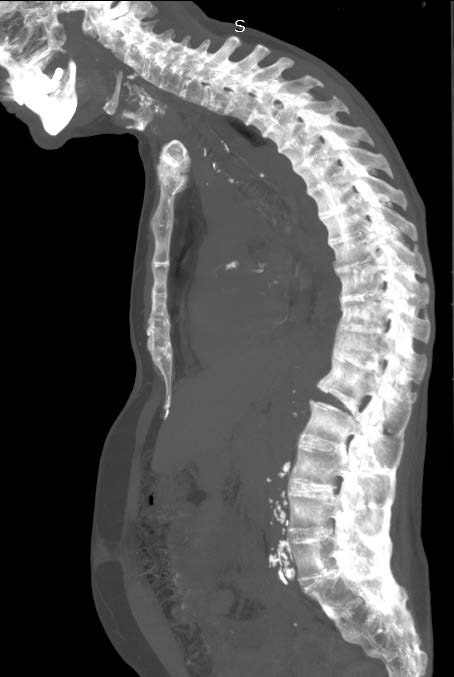
In the picture you can see a bamboo stick-like spine that is severed at the level between the first and second lumbar vertebrae. You can also see multiple ossifications in the aorta and other internal organs.
It should be noted that the immobility of the patient’s spine and head significantly complicated intubation – the insertion of a tube for artificial ventilation of the lungs – before anesthesia. The head of the Intensive Care Unit, Andriy Musienko, successfully solved this problem using a video laryngoscope. The anesthesia went without any problems.
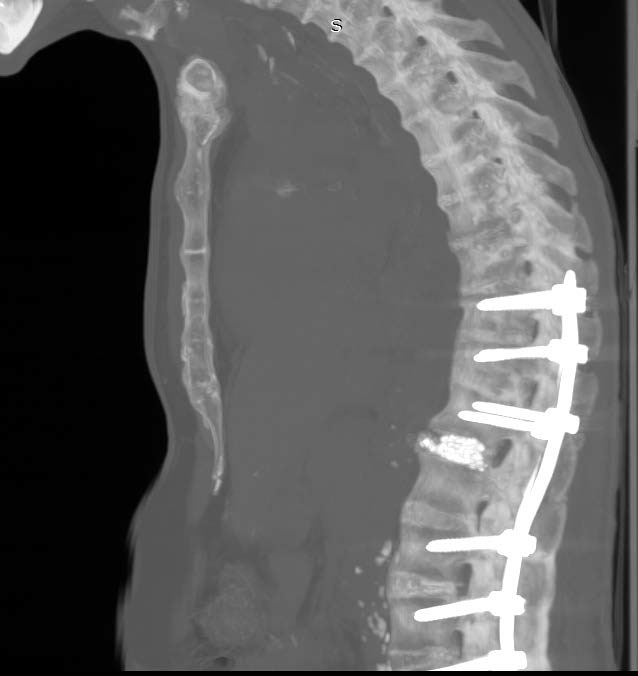
The picture after the operation clearly shows that the spine has regained its normal shape, and in the place of the rupture there is bone and artificial bone, filling the formed cavity and creating conditions for successful growth of the vertebrae. The 12-screw structure is installed as successfully and safely as possible. It reliably fixes the spine. Such operations are accompanied by little blood loss, due to minimal trauma.
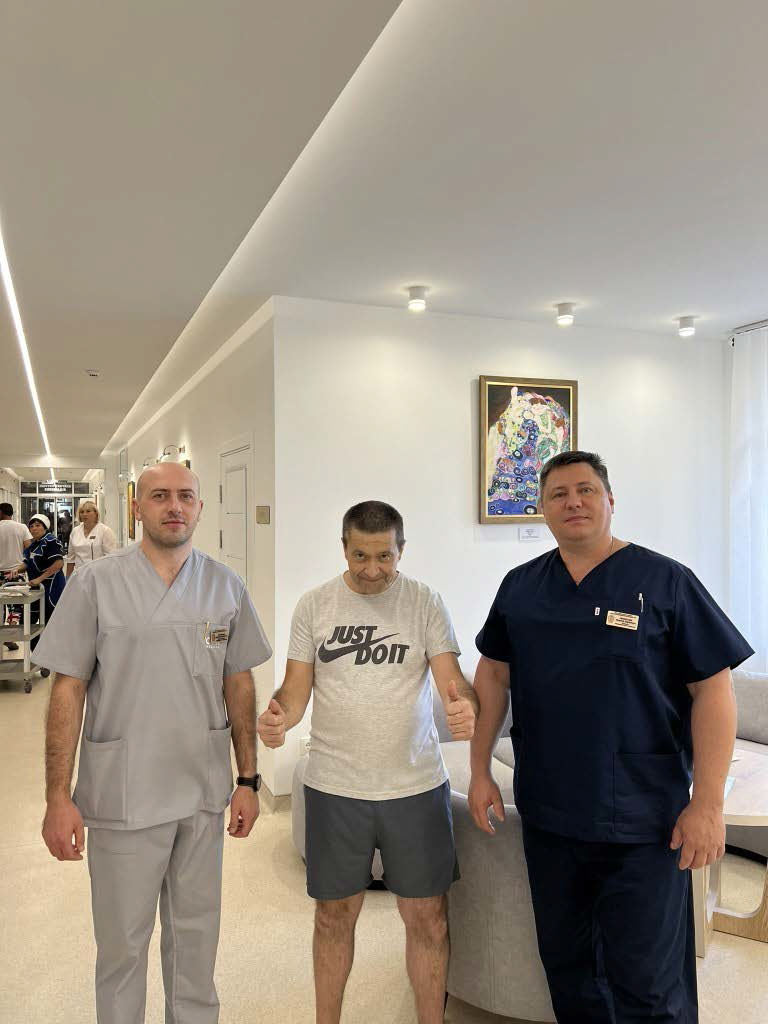
And here is a photo of a satisfied patient a week after the operation. The enchanting beauty of the department and the patient’s smile complement each other beautifully.
Our team:
- Surgeon – Candidate of Medical Sciences Leontiev O.
- Assistants – Zhuravlev O.
- Operating room nurse – Molchanova I.
- Anesthesiologist – Candidate of Medical Sciences Musienko A.
Many other specialists also participated in the patient’s recovery. The Director General of TOKPL, Volodymyr SHKROBOT, created decent conditions for this.
Photos are published with the patient’s permission.