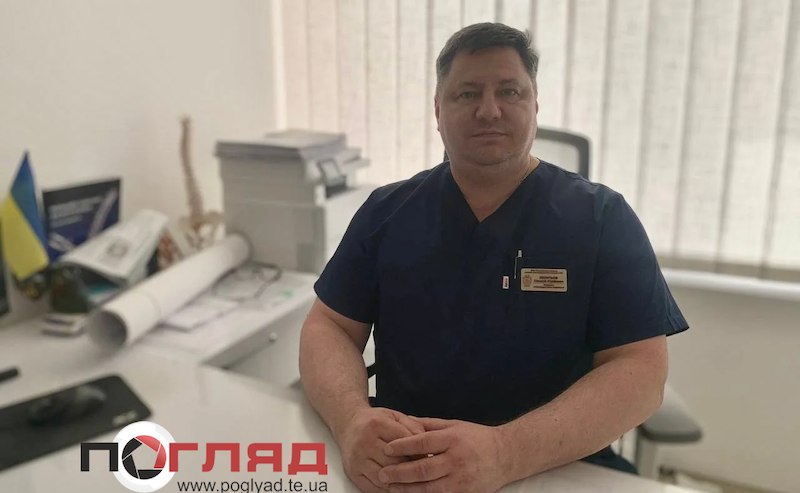
“Poglyad” begins a series of materials about neurosurgeon Oleksiy Leontiev, a doctor with over 20 years of experience, who today heads the neurosurgical department of the Ternopil Regional Clinical Psychoneurological Hospital, and before the full-scale war worked in Kherson.
In a series of interviews, we will talk about his journey into the profession – from his first shifts and work without modern diagnostics to leading the department. Separately – about his experience working during the occupation, the challenges of war, complex clinical cases, and how Ukrainian neurosurgery is changing right now.
Part ONE
A path that begins in a family of doctors and goes through operating rooms, sleepless shifts, first “touch” diagnoses, and management of one of the most complex departments in the region.
Oleksiy Yuriyevich Leontiev is a candidate of medical sciences, a neurosurgeon of the highest category. He has been in medicine since 2002, and during this time he has gone from the first shifts in difficult conditions to the head of the department.
In 2022, he headed the neurosurgical department of the Ternopil Regional Clinical Psychoneurological Hospital, where he came after working in Kherson, including during the occupation.
His professional history began long before his first independent surgery – in a family of doctors, where medicine was not a choice, but a part of daily life.
In this part, Oleksiy Leontiev talks about his path to the profession, his first years of work in the absence of modern diagnostics, his development as a neurosurgeon, leading the department in Kherson, and the challenges that defined him as a doctor and as a leader.
– Your path to medicine. What was the starting point of this choice?
– I come from a family of doctors. My mother worked all her life as a therapist at the hospital for war invalids in Kherson, and my father was a neurosurgeon in the neurosurgical department of the regional hospital.
I grew up in this atmosphere, saw the specifics of the work, understood how difficult it was. Constant shifts, delays at work, complex operations – this was part of our lives.
And somewhere along the way, I decided that I would also be a doctor. Later, a neurosurgeon.
There was no medical institute in Kherson at that time, so I went to my family in Astrakhan and entered the medical academy. It was the 90s – difficult times, so in parallel with my studies I started working in a psychoneurological dispensary – first as a medical orderly, then as a nurse. That’s where my career in medicine actually began.
Later, I was invited to an internship, and I initially completed an internship in psychiatry. But after returning to Kherson, I realized that it wasn’t quite for me.
I entered an internship in neurosurgery, which I completed in 2002 – and have been working as a neurosurgeon ever since.
– Why neurosurgery? Is it more of a father’s influence or your own choice?
– Of course, my father had an influence. But not only that. This is a very interesting specialty in itself.
Even then, I was reading and interested in areas that were just beginning to develop: functional neurosurgery, treatment of epilepsy, movement disorders such as Parkinson’s disease, and various pain syndromes.
I was very excited about it – I wanted to do it, to develop in this direction.
On the other hand, at that time it was not easy to get a job in a hospital – not everywhere they were taking me. And my father worked in a regional hospital, and there was an opportunity to work there. This also played a role.
– Do you regret this choice?
– No, I have absolutely no regrets. It’s mine.
You know, when work coincides with what you’re really interested in, it’s the best option.
– Do you remember your first years of practice? What exactly shaped you as a doctor?
– The first years were, frankly, very difficult. As soon as you come to work, you are immediately put on duty. For the first 2-4 years, I was practically on duty all the time.
These were shifts “morning to morning”, and during this time more than 20 patients with various injuries could be admitted. Most were falls, household injuries, head wounds. But there were also complex cases where immediate action was required – for example, a suspected hematoma.
There were no computerized tomography scanners back then. We used echoencephalography – this is, relatively speaking, a very primitive analogue of ultrasound. We put sensors on the head and, based on the signals, tried to understand whether there was a displacement of the middle structures of the brain. If they were displaced, then we could suspect a hematoma.
It was all very difficult and, one might say, “touchy-feely.” We had to work virtually without modern diagnostics.
But this school gave me a lot. First, I learned to quickly navigate difficult situations. Second, I developed clinical thinking – when you can assess a patient’s condition even without equipment.
Now, a young doctor first sends the patient for a CT scan and analyzes the situation based on the image. It’s much simpler.
My experience is different – I can assess the situation without it. Yes, it does not exclude mistakes, but this experience gives confidence in critical conditions.
– When did modern devices start to appear and it became easier to work?
– Computed tomography scanners also existed in those years, but they were not as accessible as they are now. For example, the tomograph was located in a polyclinic and was designed mainly for scheduled patients.
It took time to understand: CT should be primarily in the emergency department, where there are emergency cases. Later, they started implementing it, but I can’t say exactly in which year.
In addition, there were big problems with financing medicine. Often examinations were paid. And patients were brought in – for example, after injuries – without money, without documents.
And this also complicated the work, because decisions had to be made quickly, regardless of the ability to conduct a full diagnosis.
– How did you end up heading the neurosurgical department in Kherson?
– In Kherson, this happened, to some extent, due to circumstances. My father was the head of the department, but he suffered a heart attack and, unfortunately, was unable to continue leading the department. Although he continued to work there for some time.
The question arose of who would take over the leadership. There were senior colleagues in the department, and I was younger at that time, but I already had a PhD. There were no other PhDs among the doctors.
The head physician called me in and asked directly if I could “handle” such a department. And neurosurgery itself is very complex, plus there are a large number of injuries and difficult patients.
There is another aspect – people’s expectations. Many people think: if you end up in the hospital, then you must survive and fully recover. But with severe injuries, this is not always possible. Because of this, there were a lot of complaints and pressure.
I then honestly told the head physician that I understood how complex the department was being offered to me, and I understood what challenges I would have to work with. And that the question was not only whether they would “give” me this position, but also whether I was ready to take on it myself.
He also said he would think about it. As a result, I headed the department.
The chief physician at that time was a very strong leader – Viktor Klymenko. Unfortunately, he is no longer among the living.
We had a hospital that was actually exemplary: well-maintained, organized, with a strong team. He gathered very powerful department heads, and overall the level was very high.
Even before the full-scale war, cardiac surgery began performing heart transplants. That is, the development was serious.
Unfortunately, the war destroyed and changed many things.
In the second part, we will talk about the work of a doctor during the occupation of Kherson, moral dilemmas, fear, responsibility and the way to leave the city.
Communicated by Nadiya Gresa
Source https://poglyad.te.ua/personaliyi/diagnostyka-na-dotyk-i-skladni-rishennya-oleksiya-leontyeva-dosvid-likarya-z-ponad-20-richnym-stazhem.html