Yesterday, another urgent procedure for ischemic stroke , called thrombectomy, was performed at the Ternopil Regional Clinical Psychoneurological Hospital .
Ischemic stroke: a story of rescue
An 87-year-old female patient was urgently admitted to the hospital with a suspected stroke. After a computed tomography (CT) scan, the diagnosis was confirmed: ischemic stroke caused by a thrombus in the left middle cerebral artery. The patient presented with typical and alarming symptoms: significant speech impairment (aphasia), complete loss of movement in the right arm, and weakness in the right leg.
Thrombolysis: the first step to recovery
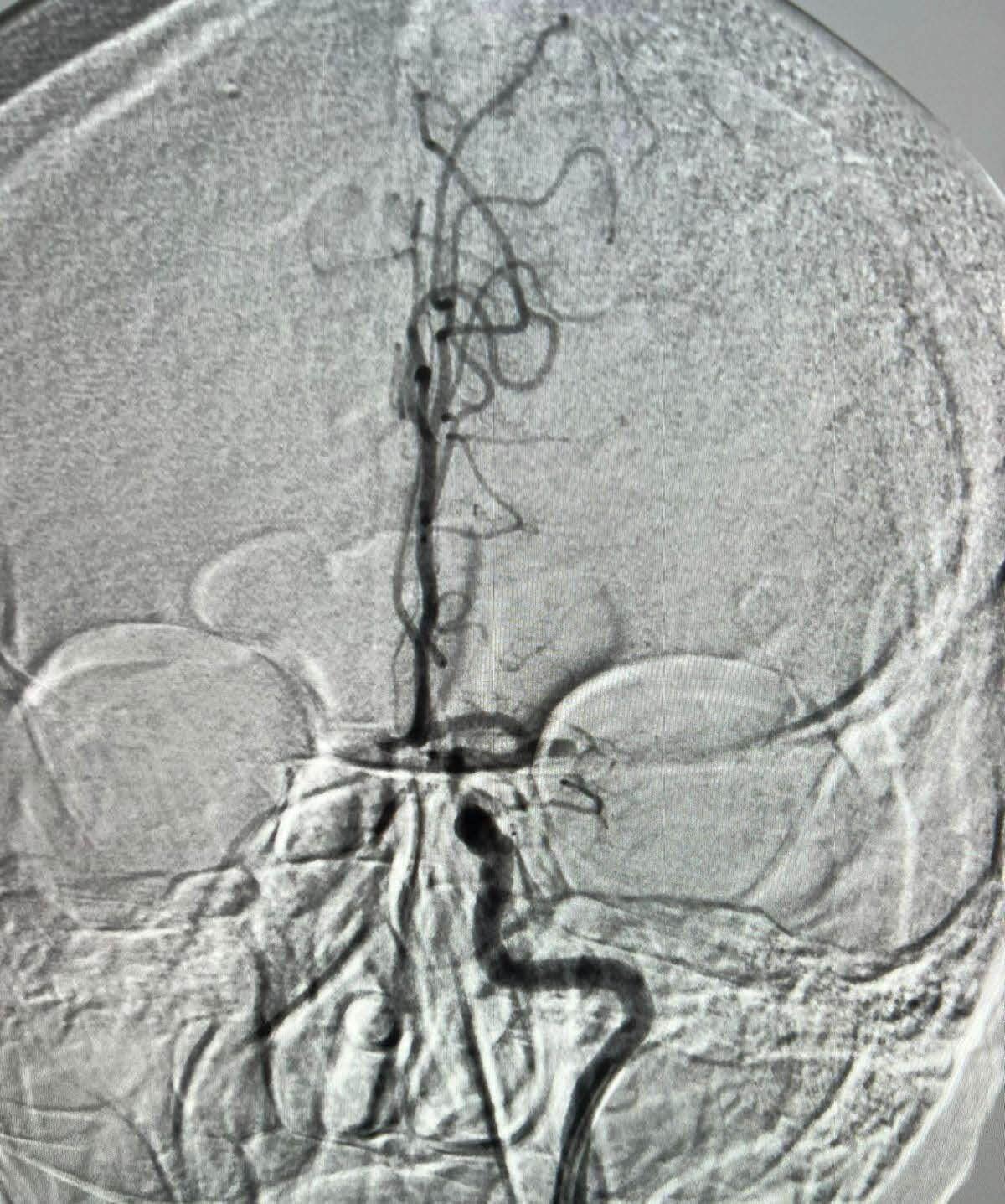
First, the patient underwent thrombolysis – that is, an enzyme that dissolves blood clots was administered intravenously. After that, speech partially recovered, but movements in the right arm and leg did not recover. Therefore, a decision was made to perform an important intervention – mechanical thrombectomy. Doctor Oleksandr Zhuravlev, who only last week returned from training in Poltava regarding mechanical thrombectomy, brilliantly performed the operation. He inserted a thin tube and a device called a stent-retriever into the vessels of the head through the femoral artery . The latter is a mesh made of thin wire that opens in the lumen of the vessel, cuts into the thrombus and is removed together with the thrombus. An aspiration catheter was additionally used. Together, by pulling out the stent-retriever and aspiration with the catheter, the thrombus was removed from the middle cerebral artery.
Mechanical thrombectomy: an innovative treatment method
Mechanical thrombectomy is a minimally invasive endovascular procedure performed to remove a blood clot from an artery. The surgeon performed this complex procedure using state-of-the-art technology. A thin catheter was inserted through the femoral artery and guided to the vessels of the head. Using this catheter, the doctor delivered a device called a stent retriever to the blood clot. This special mesh, made of thin wire, opened up inside the artery, penetrated the blood clot, and allowed the surgeon to remove it along with the mesh. Additionally, an aspiration catheter was used to better remove the remnants of the blood clot.
Result: complete restoration of blood flow and improvement of condition
Thanks to the skillfully performed operation, blood flow through the previously “closed” artery was completely restored. The next morning, the patient’s condition improved significantly: movements in her arm and leg were restored, which gives hope for a further full recovery. The problem with speech still remains, but it is expected that it will gradually recover during rehabilitation.
This story demonstrates how effective and safe mechanical thrombectomy is, even for elderly patients. Thanks to this technology, the patient was transferred from the intensive care unit to a stroke center, where she will continue her treatment. This shows that modern endovascular techniques play a key role in preserving the health and quality of life of stroke patients.
Endovascular techniques are now fully on guard of the health of patients in the Ternopil region.