Degenerative changes in the spine
Do you experience back pain that prevents you from working and living a full life? Over time, even familiar movements become unbearable? We understand how degenerative spinal diseases can affect the quality of life. Our goal is not just to relieve you of pain, but also to return you to an active and free life.
Today, spinal pathologies are becoming more and more common in medicine. Many people are familiar with pain in the spine area, which periodically occurs and may disappear for a certain time. As a rule, people do not consult a specialist to find out the cause of the pain.
If necessary measures are not taken in time, irreversible changes occur in the human body, which significantly reduce the quality of life. Such diseases include degenerative-dystrophic diseases of the spine.
What are these degenerative changes in the spine?
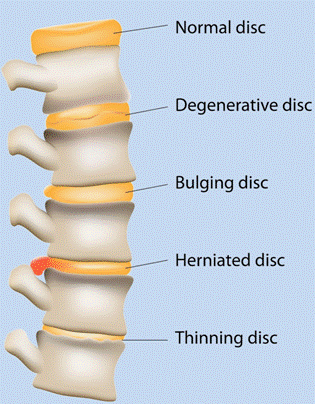
Degenerative spinal diseases are a group of chronic conditions caused by the gradual wear and tear of spinal tissues. With age or due to excessive stress, the intervertebral discs lose their elasticity and become thinner, which leads to compression of nerve endings and pain.
Most often, this pathology occurs in people of working age. Today, there is no single view on the origin of DDZH. At present, unfortunately, there are no sufficiently effective methods for diagnosing and treating this group of diseases.
Spine Anatomy:
- The spinal column is a collection of vertebrae that are arranged one above the other. Each vertebra is formed by a body and an arch. In the center of the spine is the spinal canal, inside which is the spinal cord, blood vessels, and nerves.
- The intervertebral disc is a cartilage that connects adjacent vertebrae. It consists of a centrally located nucleus pulposus and a peripheral annulus fibrosus.
- The nucleus pulposus performs a shock-absorbing function, capable of deforming under load, ensuring mobility of the spine and its protection. With age, the fluid content in it decreases.
The spine is surrounded by a muscular corset and ligamentous apparatus, which reduce the load on the discs and joints. Over time, due to various endogenous and exogenous factors, the elasticity of the cartilage tissue decreases. This becomes a trigger factor in the formation of pathological conditions.
Causes of degenerative-dystrophic lesions of the spine
- local excessive loads on spinal motor segments (SMs);
- disruption of the normal functioning of trophic systems, their decompensation.
The changes that occur in the human body over long years of illness become irreversible. That is why complete recovery of patients is extremely rare.
The main tasks of therapeutic measures are to restore normal spinal function and eliminate clinical manifestations of the disease. Osteochondrosis causes disorders of the spinal column, triggering a cascade of disorders in the functioning of the entire body.
There is an opinion that osteochondrosis is a trigger mechanism in the development of DDZH.
It is believed that this disease leads to dystrophic changes in the cartilage tissue in the spine.
Causes of osteochondrosis
- genetic predisposition,
- trophic disorders of the intervertebral disc,
- hypodynamia (insufficient physical activity),
- disruption of workplace organization,
- lifting heavy objects,
- overweight.
The progression of the pathological process leads to:
- structural changes in cartilage tissue,
- decreased mobility of the vertebrae,
- the distance between which decreases.
The trophism of the tissues adjacent to the spine is disturbed. If treatment is delayed, vertebral or extravertebral syndromes develop.
Vertebral syndromes
The reasons for the formation of these syndromes:
- compression – as a result of compression of the nerve roots,
- disfixation – against the background of impaired stability of the spinal motor segments,
- dyshemic – blood supply is disrupted in the tissues surrounding the disc at the site of spinal cord injury,
- aseptic-inflammatory – due to inflammation in the spinal motor segments.
Common types of degenerative diseases
- Herniated disc : A displacement or protrusion of a disc that results in compression of nerve roots.
- Spinal stenosis : A narrowing of the space inside the spine that compresses the spinal cord and nerves.
- Sacroiliitis : Inflammation of the sacroiliac joint, causing pain in the lower back and buttocks.
- Spondylolisthesis : Displacement of one vertebra relative to another.
- And also myofascial syndrome ,
- spinal deformities ,
- pain syndromes ,
- Osteoporosis .

Causes of the pathological condition
Factors such as:
- incorrect posture,
- excess body weight,
- lifting heavy things,
- prolonged stay in an uncomfortable position, etc.
lead to dehydration of intervertebral discs , decreased elasticity of cartilage.
The load on the fibrous ring increases, the integrity of its fibers is disrupted. Inflammation develops in the rupture sites, scar tissue is formed. The height of the discs and, accordingly, the distance between adjacent vertebrae gradually decrease.
The ligamentous apparatus stretches, the load on the intervertebral joints increases. The edges of the vertebral bodies change their position, forming osteophytes.
The intervertebral disc ceases to perform its functions, the mobility of the spine decreases, pain syndrome occurs. Thus, cartilage destruction occurs and degenerative diseases of the spine develop.
Modern methods of diagnosis and treatment
For accurate diagnosis and effective treatment, we use modern technologies such as MRI (magnetic resonance imaging), CT (computed tomography), and X-ray.
We offer a wide range of treatment methods, starting with the least invasive:
- Conservative therapy : Physiotherapy, therapeutic exercises, and medications to relieve pain and inflammation.
- Injection therapy : Blockades for rapid relief of pain.
- Minimally invasive surgery : Modern surgeries that allow you to remove a hernia or stabilize the spine with minimal trauma.
How to get advice and help?
Do not postpone taking care of your health. The sooner you contact a specialist, the more effective the treatment will be. Take the first step towards a life without pain. Make an appointment for a consultation with neurosurgeon Alexei Leontiev by phone or fill out the form on the website .