What is Morton’s Neuroma?
Morton’s neuroma is a localized growth of the plantar nerve sheath, which leads to the formation of a painful local thickening.
A neuroma is usually located between the heads of the 4th and 5th or 3rd and 4th metatarsal bones of the foot. Painful sensations of varying intensity occur when neuritis occurs.
Symptoms
Some patients describe feelings of:
- a permanent stone in the shoe,
- “nail in the sole”,
- a burning sensation also often occurs
- and numbness in the toes.
Morton’s neuroma is more common in women than in men, and the disease is promoted by wearing narrow shoes and high heels.
Excessive load on the metatarsophalangeal joints due to incorrect foot position, prolonged compression of the plantar nerve leads to damage to its sheaths with subsequent growth and formation of a neuroma with the growth of fibrous tissue around it.
Reasons
The disease is promoted by:
- excess body weight,
- work,
- associated with prolonged walking and standing.
Importantly
Also playing a role are:
- congenital foot deformities,
- flatfoot,
- condition after injuries (impacts and fractures of the foot bones).
The course of the disease is long, with periods of long remission. Exacerbations are often caused by wearing narrow shoes and physical exertion.
In the early stages, changing the height of the heel or wearing looser shoes provides relief. Over time, the pain is caused by less significant factors and lasts for a long time.
In severe cases, the pain is severe, makes walking significantly more difficult, and does not respond to any treatment methods.
Diagnostics
The diagnosis of Morton’s neuroma is based on the characteristic clinical picture, and the following are used to confirm the diagnosis:
- ultrasound diagnostics of nerve trunks,
- MRI,
- MSCT of the foot.
Treatment
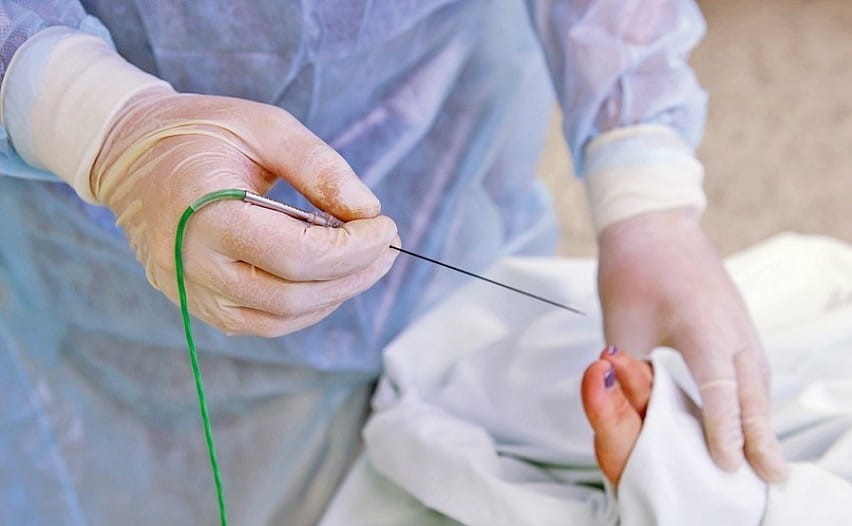
Treatment for Morton’s neuroma involves changing footwear, and some patients may benefit from orthotics. Avoid heavy physical exertion on the feet.
Used:
- anti-inflammatory topical ointments,
- therapeutic blockades,
- physiotherapy procedures,
- shock wave therapy.
If conservative treatment methods are ineffective, our department uses surgical treatment of Morton’s neuroma.
The operation is performed under local anesthesia and consists of microsurgical excision of the neuroma and membranes through a small skin incision.
After surgery, the pain usually goes away completely.
Discharge from the hospital for 2-3 days. Sutures are removed on the 10th day after the operation. After the operation, it is necessary to adhere to a gentle regimen, limit physical activity for a month.
Doctor Neurosurgeon Malyshenko M.P.