
Reconstructive and stabilizing surgeries: what is it?
These operations are surgical interventions to restore the strength and stability of the spine. Using special structures (screws, beams), we fix the vertebrae, eliminating pain and restoring movement. This helps not only eliminate pain, but also restores the function of the spine so that you can live a full life again.
When is such an operation necessary?
We resort to this method when there are serious indications:
- Injuries : If you have a vertebral fracture.
- Degenerative diseases : These are “age-related changes” such as osteochondrosis, displacement of the vertebrae (spondylolisthesis), or narrowing of the spinal canal (stenosis), which cause severe pain and limit movement.
- Tumors : In the case of tumors of the spine or spinal cord.
- Infections : Sometimes the spine is affected by infections.
Basic techniques of operations
In case of old fractures as a result of injuries or other degenerative diseases, spinal column deformities develop with the appearance of:
- secondary stenosis (narrowing of the spinal canal),
- scoliosis (curvature of the spine),
- spinal column instability (displacement of vertebrae relative to each other in different directions).
As a result, the nervous structures – the spinal cord and its roots – suffer, and their damage or compression, in turn, leads to the appearance of neurological deficits in the form of impaired movement, sensitivity, functions of the pelvic organs, etc.
Various diseases of the spine , which manifest themselves in the form of instability and stenosis , require modern neurosurgical, complex, decompressive and reconstructive operations , the methodology of which doctors of the neurosurgical department in Ternopil borrowed from training in European and American countries.
Transpedicular spinal stabilization
During this surgical intervention, screws are inserted into the vertebral bodies through the root of the brackets using special instruments, which, together with titanium beams, eliminate the pathological deformation of the vertebrae when the system is fully installed.
Control during surgery
The entire operation is performed under the control of an X-ray machine. Such control allows to minimize the risk and reduce the duration of the operation. Specially developed minimally invasive systems allow surgeons to install screws and rods, which create a supporting “framework” for the affected parts of the spine, through several small (up to 1.5 cm) skin incisions.
Advantages of the method
The undoubted advantages of this method are its:
- low-traumatic,
- cosmetic,
- reducing blood loss during surgery and shortening its duration.
In this case, the patient is usually lifted to his feet the very next day after the operation.
PLIF methodology
Posterior lumbar interbody fusion – this technique is a type of surgical intervention when, with the patient lying on his stomach, a small incision is made on the back at the level of the disease, the vertebrae are skeletonized by detaching the muscles from them, then the spinal cord is decompressed by removing part of the yellow ligament and pathological substrates that compress the spinal cord.
The second stage involves removing part of the herniated disc, expanding the intervertebral space, and preparing for the installation of an autograft (autobone) or special prostheses (cages) filled with autobone.
The graft is placed, and then the affected spinal segment is stabilized using the transpedicular fixation system described above.
The final stage of the operation is the closure of the soft tissues by applying layered sutures.
TLIF Methodology
Transforaminal lumbar interbody fusion – this technique is similar to the PLIF technique, but the difference of this surgical intervention is the resection of the facet joint, with entry into the root canal with nerve root decompression, disc resection, cage installation and finally the installation of a transpedicular fixation system and distraction.
DLIF Methodology
Direct lateral interbody fusion and the XLIF technique – extreme lateral interbody fusion – this technique provides access to the lateral surface of the vertebra and the intervertebral disc with the formation of a retroperitoneal and transpsoas corridor.
ALIF Methodology
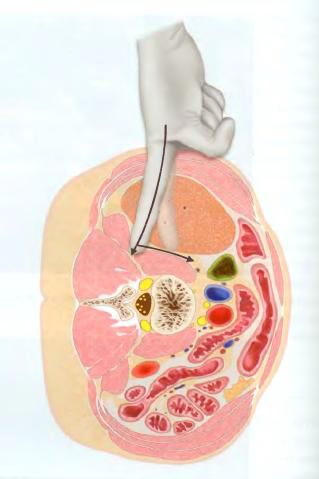
Anterior lumbar interbody fusion – this type of surgical treatment is used when access to the ventral surface of the lumbar spine is necessary.
The essence of this technique is to make a small incision on the abdomen, with penetration into the abdominal cavity. Without damaging the peritoneal sac, which the surgeon carefully removes with his hand along the inner surface of the abdominal cavity, with the determination of extremely important anatomical landmarks, the abdominal aorta and the inferior vena cava, which are carefully removed, determining the pathological focus.
Further tactics consist of partial removal of the disc, installation of an intervertebral prosthesis (cage) , installation of an anterior plate. After that, the patient, who is under anesthesia, changes the body position, turns it 180 degrees, that is, onto the stomach, and in order to stabilize it, the level of impression is stabilized using a transpedicular system.
Advantages of minimally invasive techniques
The main benefits we observe are:
- Minimal blood loss and shorter surgery duration.
- Reducing the risk of complications.
- Less pain after surgery.
- Faster rehabilitation and recovery: The patient is usually back on his feet the very next day.
What’s next? Rehabilitation!
Surgery is only half the battle. Rehabilitation is your path to full recovery. We break it down into two stages:
- Early stage (2–6 weeks) : This time is dedicated to the “basics”: light exercises, breathing exercises, learning how to sit, stand, and move properly. You may need to wear a special corset.
- Active rehabilitation (6 weeks to 3 months) : This is a period of intensive work. We incorporate physiotherapy and exercise therapy to strengthen the back and abdominal muscles that will support your spine.
Стаття написана: 22.01.2026
Стаття перевірена медичним спеціалістом: 23.01.2026

Popular destinations:
Advantages
When you consult a neurosurgeon, you can expect: