Classification
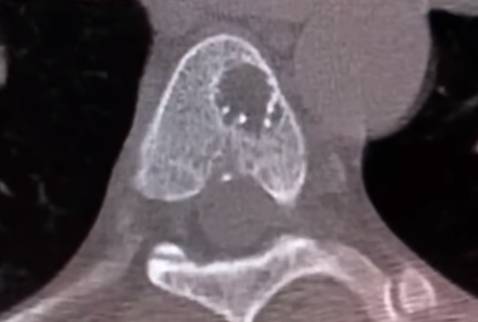
Spinal tumors are divided into:
- primary processes, i.e. those that develop directly from bone tissue,
- and secondary (metastatic processes).
Damage areas
The cancer process can develop at any level:
- cervical,
- pectoral,
- lumbar
- or the sacral region of the spine.
Primary spinal tumors
This is a less common occurrence. They are:
- benign – osteoid osteomas, osteoblastomas, hemangiomas,
- and malignant – osteosarcomas (osteogenic sarcomas), the most common tumor in children, and Ewing’s sarcoma, an aggressive tumor that affects mainly young people.
Secondary tumors
They occur more frequently and are metastases of malignant tumors from other organs, most often from the prostate, breast, lungs, or kidneys. The vertebrae can also be affected in multiple myeloma.
Symptoms
When tumors develop in the spine, they can cause:
- prolonged pain syndrome,
- spinal deformities (scoliosis)
- and neurological symptoms (if the spinal cord and roots are compressed) which manifest as paresis or impaired sensitivity in the corresponding dermatomes.
Sometimes this is accompanied by symptoms of impaired urination and defecation.
Treatment
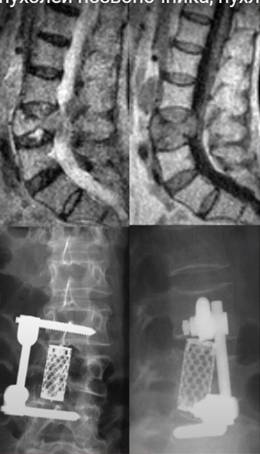
Treatment of spinal tumors is surgical, removal of the tumor can be combined with stabilization of the spine with various types of metal structures . Vertebral hemangiomas can be treated with vertebroplasty or kyphoplasty with the introduction of special bone cement into the vertebrae to restore their shape and prevent the development of pathological fractures.
Combined treatment of spinal tumors
The importance of neurosurgical intervention
It is carried out individually for each case of the disease. Oncological processes developing from the bone tissues of the vertebra often lead to compression of adjacent structures, namely the spinal cord, nerve roots, with the development of neurological symptoms. Neurosurgical removal of the tumor is, although inseparable, but only part of the treatment.
The recovery process should involve general practitioners, namely family doctors, because this is the first link to which the patient turns, neurologists – especially at the stage of diagnosis and the beginning of the appointment of conservative treatment. After the surgical part of the treatment, oncologists should be involved in the further process, because in case of malignancy of the process, patients must undergo chemotherapy and radiation therapy after surgical treatment.
And of course, physical therapy and rehabilitation are an inseparable part of the path to recovery. Therefore, in conclusion, we can say that this problem has a multidisciplinary approach.
A new method of surgical treatment of spinal tumors
The neurosurgical department has introduced a new method of surgical treatment of spine and spinal cord tumors since 2020. It consists of inserting a special conductor into the patient’s femoral artery, which is brought through the vessels under the EOP apparatus to the vessels that supply blood to the tumor.
After that, these vessels are embolized, that is, their lumen is blocked, as a result of which the tumor loses its nutrition, and later, during surgical removal of this tumor, the amount of blood loss is reduced to the minimum, which reduces the time of the operation and reduces the development of massive bleeding and hemorrhagic shock.
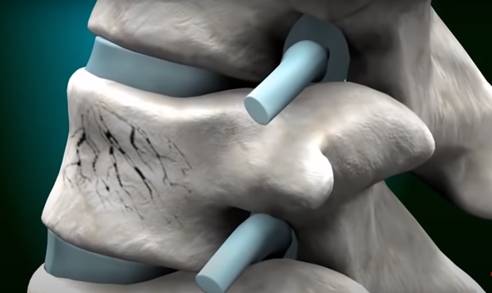
Surgical removal of a spinal tumor
If there are indications, an operation of open microsurgical removal of the spinal tumor is performed . The operation is performed according to the principles of oncological surgery with the maximum possible resection of the affected area of the bone to “healthy tissue” with the elimination of compression of the nervous structures. After major operations with the removal of entire vertebrae, special implants and prostheses are installed to fix the unstable spinal segment.
The radicality of the operation performed is determined by the histological structure of the tumor, the involvement of the spinal cord and roots in the process.
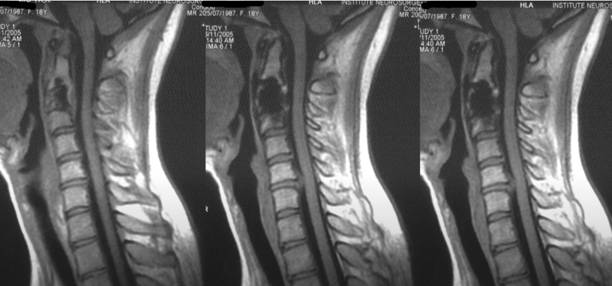
In the case of benign spinal tumors , after total removal of the tumor, in most cases, a complete recovery can be achieved.
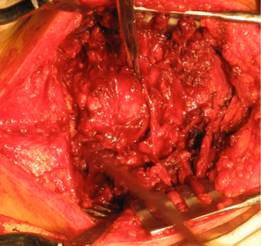
In malignant spinal tumors, radical surgery is difficult to achieve even at the current stage of neurosurgery. But even in these cases, surgical removal of the spinal tumor significantly reduces pain, improves the function of the spinal cord, which was compressed by the tumor, and prolongs the period of relatively good health of the patient with a satisfactory quality of life for months and years (depending on the degree of malignancy of the tumor).
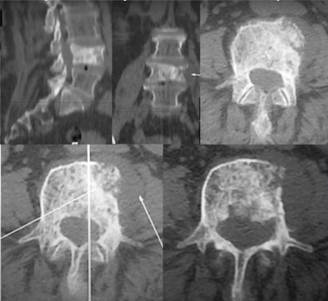
Koval Artem
Стаття написана: 22.01.2026
Стаття перевірена медичним спеціалістом: 22.01.2026

Popular destinations:
Advantages
When you consult a neurosurgeon, you can expect: